ISO 14001 Update from Arthian – blog post
Date Posted: 17 Apr, 2026
Learn What the Update Means for Environmental Leadership
More than 10 years on from the last major update in 2015, the environmental management systems standard ISO 14001 is being updated, with ISO 14001:2026 expected for publication mid‑April. This is not a radical rewrite, but it is a meaningful evolution – one that reflects how environmental management, climate risk, life cycle impacts and supply‑chain accountability have moved firmly into mainstream business decision‑making.
Importantly, ISO 14001 remains aligned with Annex SL, continuing to support integration with quality, health & safety and wider management systems. For organisations already running a mature EMS, the update should feel familiar – but it also raises expectations around leadership, risk, and how we understand our interaction with the natural environment.
Why the change matters
ISO standards are periodically revised to remain relevant. This update formally embeds the climate change amendment introduced in 2024, expands guidance through a much stronger Annex A, and tightens alignment with ISO’s harmonised management system structure.
The direction of travel is bringing environmental management closer to core business management. Expanding on the life cycle approach to organisations’ environmental aspects and impacts, it is about understanding how organisations depend on – and impact – wider environmental and ecological systems, and how those dependencies translate into real business risk and opportunity.
Key themes in ISO 14001:2026
One of the most significant shifts sits in Clause 4 – Understanding the organisation and its context. Climate change considerations are now fully embedded, with explicit reference to pollution, resource availability, biodiversity and ecosystem health. This brings external environmental realities directly into strategic decision‑making. For many organisations, particularly those reliant on complex supply chains, this creates a much clearer line of sight between environmental degradation and operational resilience.
The standard also clarifies expectations around the Environmental Management System itself (Clause 4.4). There is greater emphasis on integration with existing business processes, rather than maintaining parallel “EMS-only” procedures. The focus is firmly on environmental performance outcomes, not paperwork.
Leadership expectations are strengthened (Clause 5.1). Senior leaders are expected to actively promote a culture that engages people across the organisation – and beyond it – in delivering EMS objectives. There is an explicit link between leadership behaviour, trust with interested parties, and collective progress on shared challenges such as net zero and sustainable sourcing. This reflects the reality that no organisation improves environmental performance in isolation.
In Clause 6, several important clarifications and additions appear. Environmental aspects and impacts now place greater emphasis on life‑cycle thinking, including influence and control across the value chain. There is reassurance that formal life‑cycle assessment is not required, but the expectation is that organisations think more systematically about upstream and downstream impacts – including potential emergency situations.
A new Clause 6.1.4 on Risks and Opportunities requires a documented process. This aligns ISO 14001 more closely with other management standards and strengthens the link between environmental aspects, climate risk, biodiversity loss and strategic opportunity. Circular economy approaches and nature‑positive land management are explicitly recognised as opportunities, not just ethical aspirations.
Another notable addition is Clause 6.3 – Planning of Changes. Environmental change management is now formalised with its own new clause. Whether changes are driven internally or by external factors such as extreme weather, geopolitical shifts or regulatory change, organisations are expected to plan, assess impacts and adjust their EMS in a structured way.
The changes to Internal Audit (Clause 9.2) and Management Review (Clause 9.3) are largely about clarity and structure rather than new intent. Management review, in particular, is now more clearly laid out around defined inputs and outputs, making it a more effective leadership tool rather than a compliance exercise.
What this means in practice
For organisations already certified to ISO 14001:2015, this is an evolution, not a reset. Many of the concepts will already be in place. However, the revised standard is more explicit, more prescriptive in places, and much clearer about expectations around climate risk, leadership engagement and change management.
The expanded Annex A guidance is where much of the real value sits. It supports more consistent interpretation and encourages organisations to view performance through a genuinely environmental lens – internal and external.
Timing, transition and actions
ISO 14001:2026 is expected to be published in April 2026, with a transition period likely to be up to three years. Existing certificates will remain valid during this period, but early planning is strongly advised. Certification bodies will also need time to complete their own accreditation.
This creates a valuable window to step back, assess gaps, and strengthen systems in a controlled and strategic way.
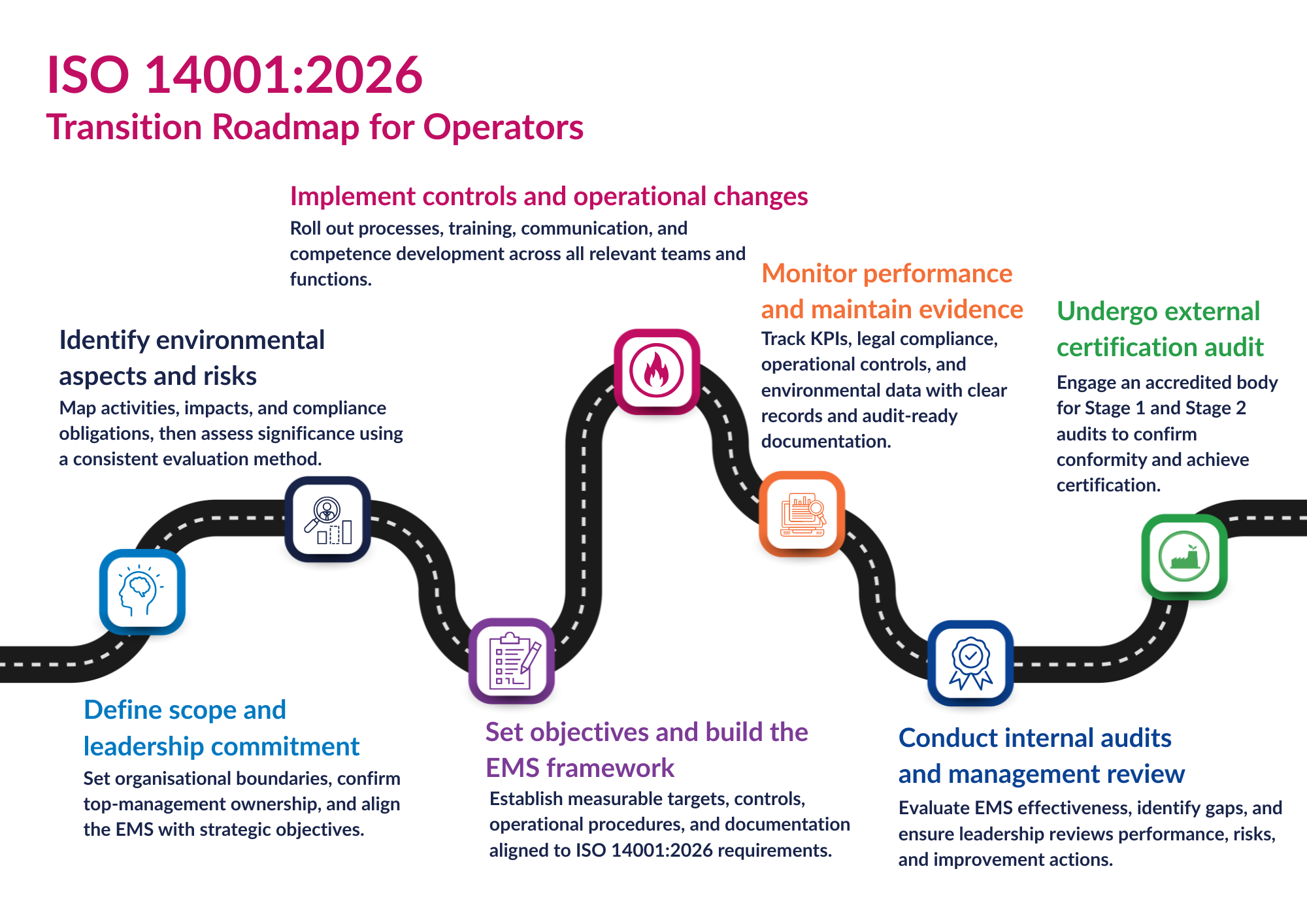
Actions may include:
*Undertake a structured gap analysis against the revised ISO 14001:2026 requirements
*Reassess environmental aspects and impacts, including climate, carbon, biodiversity and value‑chain considerations
*Confirm compliance evidence is current and robust, with records aligned to regulatory and permit requirements
*Refocus procurement and product life‑cycle value chains through the lens of improved environmental management and influence
*Upskill key roles through targeted coaching and training, ensuring teams understand the intent and practical implications of the new standard
*Check in on your company culture – does this align with the ethos of the new standard?
*Carry out a deep‑dive review of EMS performance data, asking the critical question:
are we genuinely demonstrating improvement, capitalising on opportunities and effectively minimising environmental risk?
*Train your internal audit team to audit to the new requirements.
Final reflection
ISO 14001 remains a powerful framework when used with intent. The 2026 update reinforces that environmental management is about leadership, collaboration and long‑term resilience – not just compliance. For organisations prepared to engage thoughtfully, this revision genuinely supports better decisions, stronger supply‑chain relationships and more credible sustainability performance.
The Author:

Director of the Sustainability Group at consultancy Arthian and with over 25 years’ experience working alongside engineering and industrial companies, Geraldine Boylan is a respected specialist in environmental management systems.
With her team, she has designed, implemented, trained and internally audited EMS frameworks using ISO 14001, supporting organisations ranging from high‑hazard, environmentally permitted sites to growing SME operations. Geraldine, a Chartered Environmentalist and Fellow of ISEP, brings a systems‑led approach that connects environmental compliance with wider sustainability priorities, including climate risk, carbon reduction and biodiversity impact, helping organisations strengthen resilience and long‑term performance. She has a passion for business, processes and supporting environmental improvements.
Renfrewshire Chamber member, Arthian are a multi-disciplinary consultancy, formed by merger of Mabbett (HQ Glasgow) and IKM (HQ Grangemouth), both well-known for industrial and high hazard process compliance, energy, decarbonisation and EHS good practice support. Arthian combine the technical expertise across nine specialist groups in order to deliver client solutions in an integrated and efficient way. To connect or have an initial chat about your site needs, contact Geraldine.boylan@arthian.com or 0141 227 2300.